In today's world, where the AI wave is sweeping the globe, the threats posed by deepfakes and fake news are becoming increasingly serious. Teaching the next generation to distinguish truth from falsehood and to possess critical thinking skills in media and information literacy has become a pressing issue for Hong Kong's education sector.
The Hong Kong Education Bureau is strongly supporting schools in implementing related education programs. The Quality Education Fund (QEF) has launched the "My Action Pledge – Enhanced Version" and... "My Commitment to Action - Enhanced Phase Two"Funding provides a golden opportunity for schools to launch innovative AI-based media literacy education.
However, many school staff are confused by the three parallel plans (standard, enhanced, and second phase), different application deadlines, and non-overlapping rules.
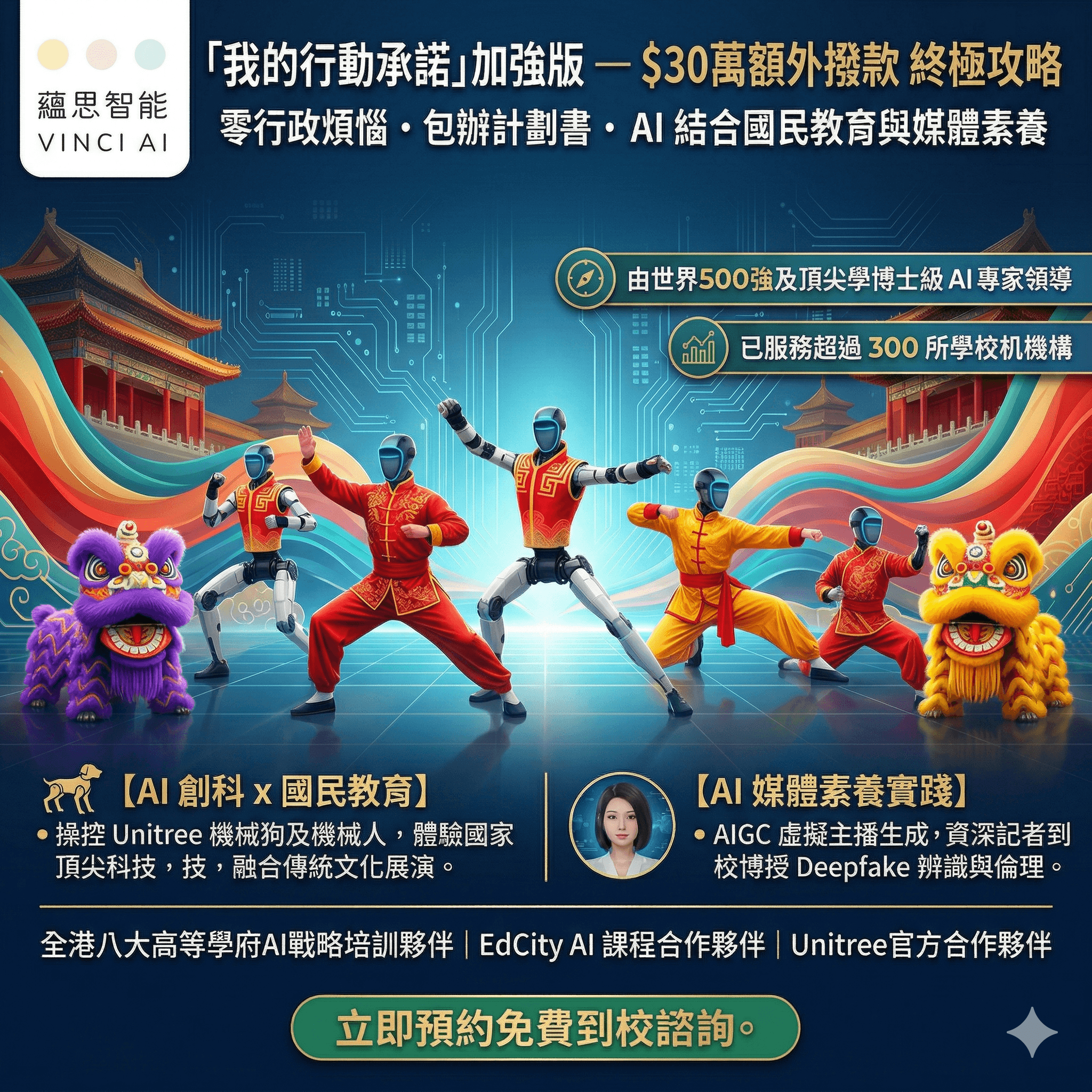
ThisUltimate GuideThe aim is to provide a detailed breakdown of the "My Action Commitment" series of funding for schools across Hong Kong.Key detailsand introduce Vinci AI How to provide a one-stop solution to help perfectly execute a brilliant AI media literacy practice project.
Funding Strategy Guide (Part 1): Clarifying Three Parallel Plans
First, schools must clarify that QEF currently offers three parallel My Action Commitment funding programs, each with different goals, durations, and themes.
The most basic is the "Standard My Action Commitment Funding Program," themed "Gratitude and Appreciation, Positive Optimism," with an application deadline of August 31, 2026, which aims to cultivate students' positive values.
The school's focus should be on the additional "Enhanced Version of My Action Commitment".The plan's objectives are very clear, focusing on two core areas: "1. National education and national security education" and "2. Media and information literacy education." The funding cap for primary and secondary schools is as high as [amount missing].HKD 300,000, and the application deadline is also [date missing]. August 31, 2026.
Then, on September 1, 2025, QEF launched "Enhanced My Commitment to Action Phase 2".It continues the two main themes of the "enhanced version," andA third option has been added: "3. Promote students' physical and mental health" to address students' health needs in the post-pandemic era. The funding cap for the second phase remains at NT$300,000 (primary and secondary schools), but the application period has been significantly extended. August 31, 2028.
Most importantly, both of these "enhanced" grants areAdditional funding,Won'tIt also affects the school's application for other QEF grants.Won'tIt will be counted within the school's regular application quota.
Funding Strategy Guide (Part 2): Strategic Choices and the "No Overlap" Rule for Schools
How should schools strategically deploy these plans? The key lies in understanding "Non-Concurrent Rule」。
QEF stipulates that schoolsThe "Enhanced Version (E My Action Commitment)" and the "Second Phase (E My Action Commitment Phase 2)" cannot be implemented "simultaneously".This means that the school must develop a long-term development plan.
Vinci AI's strategy recommendations are as follows:
- If your school "never" applied: suggestionApply now for "My Action Commitment Enhanced Edition"Since the application deadline is August 31, 2026, time is tight. You can first use this grant to implement the "Media Literacy" or "National Education" project, and after the project is completed (e.g., in 2026), you can seamlessly apply for the "Phase Two" to maximize resources and achieve a total of $300,000 + $300,000 in potential funding.
- If your school is already implementing my action commitment: You must wait until the existing project is completed and a closing report is submitted before you can initiate the "Phase Two" application.
- If your project includes elements of "mental and physical well-being": "Phase Two" is your best choice, as its newly added "Mental and Physical Health" theme provides schools with greater flexibility.
Funding Guide (Part 3): Where can the money be used?
After receiving the $ 300,000 yuan grant, the school's primary concern is the flexibility of its spending. This grant is not limited to purchasing supplies; its uses are quite extensive and can truly relieve teachers of administrative burdens.
Hiring staff
This is the most crucial favorable policy. Funding cannot be used to hire additional permanent teachers, but it can be used to hire:
- Substitute Teachers: This is intended to free up the teaching time of the teachers responsible for implementing this project.
- Teaching Assistants: Hire additional staff specifically to assist with event implementation, paperwork, and administrative tasks.
Procurement of external services
This is the most common and efficient use. Schools can use grants to purchase "AI Media Literacy Hands-on Courses" offered by companies like Vinci AI, which cover all aspects of the program, including tutor fees, textbook design, workshops, field trips, and even post-course exhibitions.
Audit Fees
QEF is very strict about the use of public funds. For any project with approved funding exceeding HK$100,000, an audited statement by a licensed accountant must be submitted upon project completion. QEF has taken this cost into account and allows schools to set aside up to HK$$5,000 in their budget for this audit fee.
Overseas study activities (subject to funding cap)
If the project involves exchanges with mainland China (e.g., in line with the theme of "National Education"), schools must be aware that QEF does not reimburse all travel expenses; rather, it has very detailed allowance standards. For example, in Asia/Mainland China, the maximum allowance per student is $6,500.
- Fully subsidized students: You can receive 100% in funding (i.e., a maximum of $6,500).
- Students receiving half-subsidy: You can receive 75% in funding (i.e., a maximum of $4,875).
- General students: You can receive 50% in funding (i.e., a maximum of $3,250).
Funding Strategy Guide (Part 4): How can Vinci AI solutions perfectly align with funding?
Our "AI Media Literacy Practical Course" is a 100% course that aligns with the "My Action Commitment - Enhanced Edition" curriculum.Media and information literacy educationThe theme is "Proposal".
1. Addressing the school's pain points
We are well aware of the administrative and compliance pressures that schools face when applying for funding.
- Administrative burden: Teachers already have a very heavy workload. Vinci AI provides [this solution].Ready-made project proposal templateWe have dedicated staff to assist schools in following up on application documents, greatly reducing the burden on our colleagues in writing proposals, truly making it "worry-free".
- Solution Design: How do you design a solution that is both in line with "media literacy" and innovative? Our course combines AI, ethics, and practice, and is innovative and fully in line with the "critical thinking" ability encouraged by QEF.
- Procurement compliance (national security review): The QEF guidelines explicitly require that schools, when procuring external services,mustEnsure that suppliers and speakers comply with national security laws and review teaching materials. Vinci AI, as a leading AI education institution in Hong Kong (an Education City partner), ensures that all its courses are taught by a team of Hong Kong PhD-level expert lecturers. With clear and transparent course outlines, Vinci AI is the most reliable and compliant choice for schools.
2. Our solution has three main pillars.
We believe that true media literacy education should not only focus on "distinguishing truth from falsehood," but also on "showcasing creativity."
First: AI-generated video (AIGC technology)
Students will say goodbye to traditional presentations and get hands-on experience with cutting-edge AI tools. They will learn to use AI to generate videos from their speeches and create their own "AI virtual anchors" (avatars) to produce professional-grade feature films for the campus television station, showcasing AI creativity.
Second: Guidance from professional journalists (media ethics)
We have exclusively invited a "senior professional journalist" to the school to conduct workshops for students. The journalist will use real-life cases to personally teach media ethics, deepfake identification techniques (fact-checking), and information literacy for the AI generation, fundamentally building students' critical thinking and discernment abilities.
Third: Embodied Intelligence and Robotics "China's Latest Technological Developments" Training Camp (Exclusive to Unitree Official Distributors)
To further deepen the theme of "National Education and National Security Education", we have specially launchedVinci AI Embodied Intelligence and Robotics Short Course ProgramThis allows students to experience firsthand China's globally leading Embodied AI technology. As the official Hong Kong partner of Unitree, a world-class robotics company, Vinci AI can directly import enterprise-grade robots, allowing students to have direct contact with China's national technological achievements in the robotics industry, from "following" to "leading".
The course offers four flexible options:
- Unitree R1 Humanoid Robot 1-Day HackathonStudents used Python to develop visual recognition and posture control technologies to complete the "AI Intelligent Greeting Service" project, gaining an understanding of the core technologies for national robot self-reliance and self-improvement.
- Unitree Go2 Bionic Robot Dog 1-Day HackathonExperience 4D LiDAR spatial mapping and group dance, fostering teamwork and a positive and optimistic attitude.
- School-wide STEM Day Grand PerformanceA large-scale, spectacular performance featuring the R1 humanoid robot and the Go2 robotic dog, showcasing the nation's latest technological achievements, can serve as an opening event for national education.
- Regular Semester On-Campus Residency ProgramIt is conducted in multiple sessions, making it ideal for long-term integration into school-based curricula.
Why choose Vinci AI?
We understand the school's needs and possess the strongest execution capabilities and brand guarantee:
- ServeMore than 300Primary and secondary schools and institutions
- We have provided AI training to faculty and students at eight local universities.
- EdCity, Hong Kong AI Online Coursessupplier
- 由PhD-level AI expertandUniversity lecturerTeaching team design
Seize the last opportunity for the $ 300,000 grant
The application period for the "My Action Commitment - Enhanced Edition" (E My Action Commitment) grant is less than two years.Deadline: August 31, 2026This "extra" $ 300,000 grant is the best springboard for schools to promote AI media literacy education and equip students with key skills for the future.
Vinci AI invites all primary and secondary schools in Hong Kong to seize this "zero-cost" opportunity for innovation.
Take action now!
Contact Vinci AI to get a ready-made project proposal template and free course consultation.
Let us help you easily apply for the $ 300,000 grant to launch your "AI Media Literacy Practical Course"!
- Telephone: +852 9738 2471
- e-mail: [email protected]