AI Lab Construction x Intelligent Data System x School-Based Curriculum
QEF Quality Education Fund Program
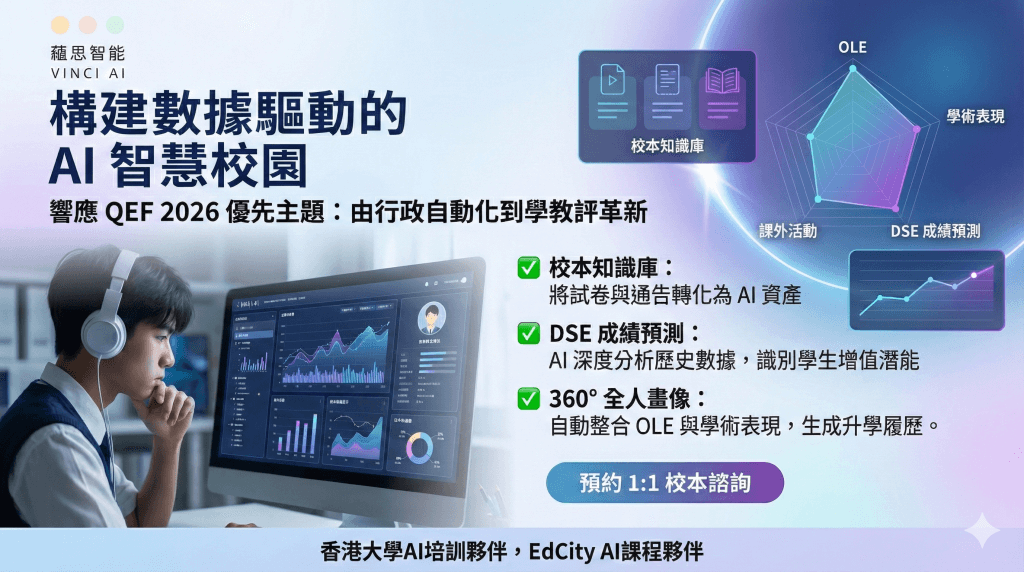
Vinci AI offers a one-stop QEF solution, perfectly integrated with AI Lab.Construction,School-based AI system and Interdisciplinary coursesWe help schools build AI innovation centers, deploy local data brains, and implement accurate prediction of DSE results, 360° holistic development profiles, and administrative automation. We leverage funding to build a data-driven smart campus that is both technologically advanced and sustainable.
QEF Quality Education Fund Program - Building a Sustainable AI-Powered Smart Campus
Traditional STEM rooms often degenerate into hardware showrooms. Successful AI education requires three pillars, and Vinci AI provides comprehensive planning for you.
The Data Heart of the Campus
AI Lab Construction
The school is building an AI computing center, with a specially designed transparent server room.Local GPU computing powerBy making the data physical, students can visually see the data flow, turning the computer lab into the most powerful STEM teaching tool.
Flexible partitioning design: Breaking away from the traditional computer lab layout, it features a robotics competition area, a programming collaboration area, and a lecture hall, supporting diverse teaching modes such as project-based learning (PBL).
Professional engineering coordination: Includes power load upgrades, network cabling, and soundproofing works, meeting the Education Bureau's standards.
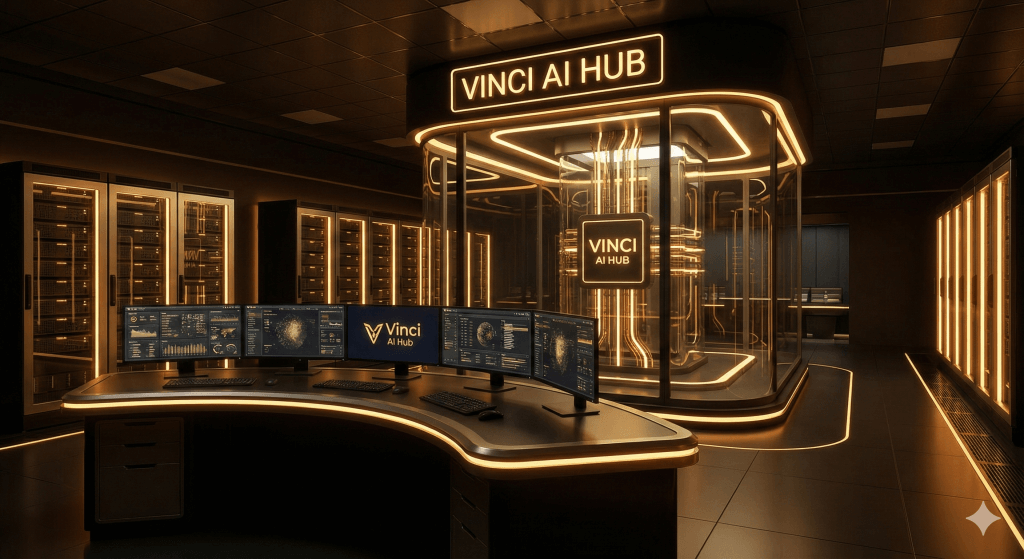
The intelligent brain for learning, teaching, assessment, and management (servers deployed within the lab)
School-based AI Data Platform
📈 DSE Smart Navigation (Score Prediction): Say goodbye to arbitrary estimations. Systematic deep learning based on ten years of school-based data...Accurately predict students' academic performance and potential for growth.This helps teachers identify borderline cases early and provide targeted support and remedial care.
👤 360° Holistic Personal Profile (Full Person Portrait): Reject data fragmentation. Automatically integrate academic, activity (OLE), and service records to generate...Visualization Capability Radar ChartIt generates a wealth of recommendation letters and student profiles with a single click.
⚡ Rapid Automated Administration: Free up teachers' time. AI learns the style of official school documents.Instantly generate parent notices, meeting minutes, and test paper analysis reports.Let teachers return to their teaching profession.

Empowering teachers and students' soft skills
School-based curriculum and training
As a trusted AI education partner of organizations such as Hong Kong Education City and the Gifted Education Institute, we have provided AI courses to over 25,000 students. We offer student activity programs focused on enhancing students' AI literacy and skills:
AI-driven innovation practice activities: supply LLM AI Agent Design and Unitree Robot ProgrammingAI courses will be offered, where students will learn LLM model development and programming to control humanoid robots, building their own campus AI agents and transitioning from users to developers.
Interdisciplinary textbook licensing: The AI Lab comes with a complete set of school-based textbooks (covering Python data analysis, LLM principles and robot control).
Seed Mentor Training (Train-the-Trainer): 100 hours of in-depth AI training videos, and the establishment of a core team of teachers within the school to ensure that teachers can confidently operate the hardware and software facilities in the AI Lab.

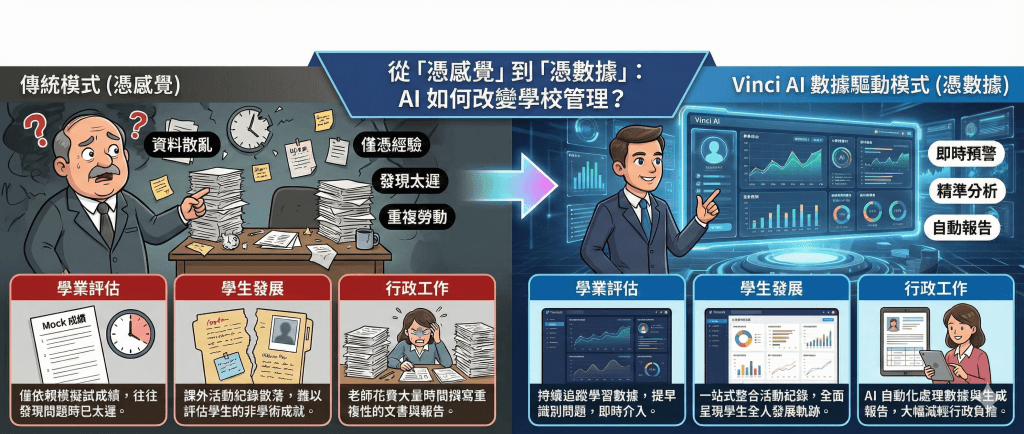
From "based on intuition" to "based on data": How is AI changing school management?
Traditional management often relies on experience or outdated assessment data. Vinci AI, through in-depth mining of school-based big data, transforms the decision-making model to an evidence-based approach. From accurately predicting students' potential for growth to quantifying students' holistic development trajectory, AI helps schools eliminate subjective blind spots and identify students' strengths and weaknesses early on. This ensures that every teaching strategy and resource allocation is guided by objective data, achieving scientific and efficient management.
Request a complete solution introduction
You can get a complete introduction to the QEF Quality Education Fund program by filling out the form only once. (After submitting the form, the resource library link will be sent to your email immediately.)
Want to learn more about high-quality education fund programs?
Bring your ideas to life.
Whether you're looking to renovate an old computer room or build an innovation center from scratch, our team of consultants can provide you with comprehensive support.Floor plan design到Curriculum PlanningOne-stop advice.
If you are interested in the following areas:
☑ AI Lab Design and Decoration
☑ School-based AI Data System
☑ AI Courses and Teacher Training
Feel free to contact us for inquiries.
QEF Special Funding Scheme – Frequently Asked Questions (FAQ)
The fund sets reference total funding amounts for different types of schools. Kindergartens are approximately... 500,000 yuanPrimary schools, secondary schools, and special schools are approximately [amount missing]. 2 million yuan The school may submit one or more applications as needed for development.
Yes. Applications under this special grant scheme will be considered in conjunction with other grant schemes of the fund.Handle separately,andNot subject to current application quota restrictions Even if your school's current QEF quota is full, you are still eligible to apply for this special fund.
Yes, but specific conditions must be met. The scope of funding explicitly includes relevant [funding categories].School building improvement projectand/orMaterial ProcurementThe prerequisite is that these projects must be used to implement "school-based curriculum design" or "student support measures".Simple renovations may not be approved, but alterations made to accommodate new curricula (such as the creation of innovative learning spaces) are eligible for funding.
To ensure that the funding yields results in a timely manner, the implementation period for each application plan is generally [number] years.No more than three years Schools should develop a three-year development plan, for example, the first year for infrastructure construction and procurement, and the second and third years for curriculum implementation and evaluation.
Special grants are reviewed primarily based on five categories, with "Plan Needs" (35%) carrying the highest weight. "Plan Feasibility" (25%) .
The plan requires: The emphasis is on "innovation," such as including novel ideas that benefit the beneficiaries or improving existing methods. .
feasibility: The school must demonstrate that it has the necessary conditions or facilities to implement the plan, including teacher professional development. .
This is one of the review criteria (accounting for 10%). Applicants need to demonstrate that the project's outcomes are sustainable, for example, by providing a plan that allows the main activities to continue after the funding ends. It is generally recommended to demonstrate continuity by establishing a school-based teaching material library, training key teachers, or purchasing permanent assets (such as servers or knowledge base systems).
The fund accepts applications in two phases each year. The application period for the sixteenth special grant program is as follows: April 2026 to July 2026 Schools must submit electronic applications through the "Online Program Management System". .