From quadruped to humanoid: Embarking on a journey into the future of AI programming.
Unitree AI Robotics Programming Course
How can we ensure students master robotics technologies from basic to cutting-edge? How can we ensure that schools' AI courses are aligned with the world's leading technologies and seamlessly connect with the future?
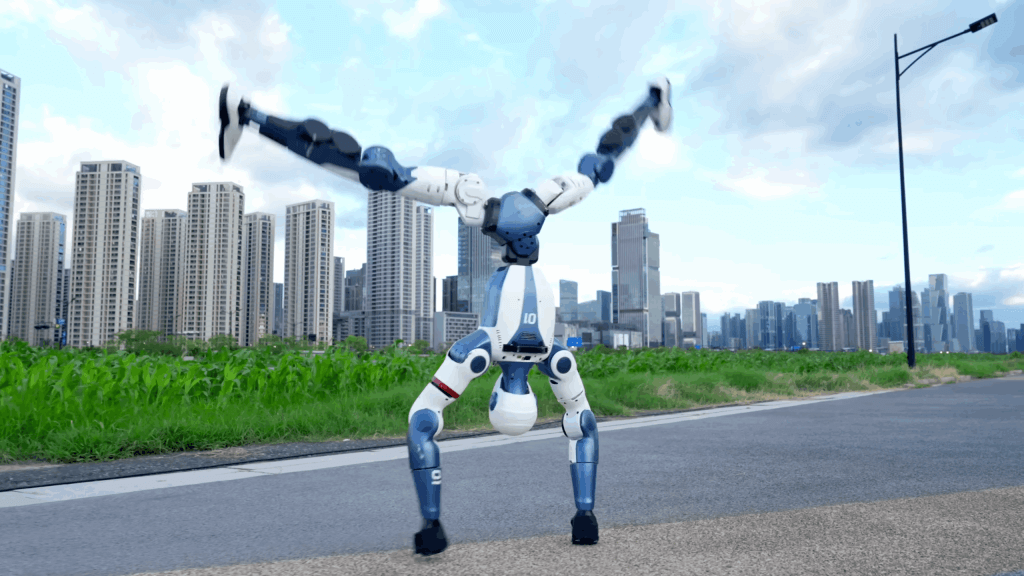
Vinci AI proudly presentsUnitree Go2 & R1 AI Robotics Programming CourseWe will guide students, starting with controlling the flexible and agile Go2 quadruped robot, and gradually moving towards the higher level of mastering the cutting-edge humanoid robot R1, providing a complete learning path from graphical introduction to professional Python development.
Through the curriculum design and support of our PhD-level AI experts, your students will be able to program robots by hand, giving them life and truly mastering the core skills of Embodied AI, laying the most solid foundation for future development in the field of artificial intelligence.
Course topics include:
- Graphical Programming: Drag-and-Drop Logic and Flow Control
- Advanced Python Programming: Official SDK and Low-Level Control
- Robotic Operation System: ROS2 Framework, Node Communication and Visualization Tools
- AI Vision Applications: Object Detection, Image Recognition and Tracking
- Autonomous Navigation: LiDAR Sensor Applications and SLAM Map Building
- Human-computer interaction: speech recognition, speech synthesis and command execution
Why choose our Unitree course?
A unique path to advancement
The course covers the Unitree series, from the globally popular Go2 quadruped robot to the forward-looking R1 humanoid robot, providing a coherent and in-depth learning experience that allows students to fully understand the evolution and future of robotics technology.
Programming spectrum from beginner to professional
We have designed suitable teaching programs for students of different ages. The beginner courses utilize the official app's graphical drag-and-drop programming and the DroneBlocks platform, making it easy for elementary school students to get started; the advanced courses delve into the Python SDK and ROS2.
Real-world AI hardware applications
The course utilizes both the Go2 EDU and R1 EDU models, both equipped with the powerful NVIDIA Jetson Orin NX computing platform. Students will learn to leverage up to 100 TOPS of computing power, combined with sensors such as 4D LiDAR and binoculars, to implement cutting-edge AI applications such as object detection, SLAM map building, and autonomous navigation.
Champion-level mentor team
The course is designed by a team of university lecturers and PhD-level AI experts from YunSi Intelligence. Our instructors possess extensive teaching and practical experience, simplifying complex concepts such as kinematics and sensor fusion, guiding students to solve real-world problems, and cultivating research thinking.
Regarding the robots used in the course
This course uses two cutting-edge robots, Unitree Go2 and R1, to build a unique learning path from beginner to professional.
Unitree Go2 As a starting point for learners, it offers a complete official app for drag-and-drop programming and the DroneBlocks teaching platform, allowing beginners to easily grasp program logic. Its EDU version, equipped with NVIDIA Jetson Orin and 4D LiDAR, provides a powerful hardware foundation for AI beginners.
Unitree R1 It serves as a bridge to advanced research and development. The core of this advanced humanoid robot lies in its mature Python SDK and deep integration with the industry standard ROS2. Students will learn professional robot software architecture on this platform and utilize its powerful Jetson Orin core to develop complex AI applications such as deep learning and voice interaction.
From quadrupedal to humanoid, this course provides students with a complete ladder from AI enlightenment to professional research and development.
Course Design and Core Content
Our curriculum is divided into two main phases, progressing step by step and spanning the entire learning process from primary to secondary school.
This course provides a complete learning path for robot programming, from beginner to professional. In the initial stage, students will use the Unitree Go2 robot, its official app, and the DroneBlocks platform. Through drag-and-drop graphical programming, you can easily master the basic logic of path planning and obstacle detection. .
The advanced stage will transition to Python programming, where students will learn to use the official SDK (unitree_sdk2_pythonThe industrial-grade ROS2 framework enables precise control of the Go2 and R1 humanoid robots. .
The course will delve into DDS communication and sensor data processing, and utilize tools such as RViz to achieve professional-grade status monitoring and visualization. Finally, the trainees will leverage the powerful AI computing capabilities of the robot's built-in NVIDIA Jetson Orin processor. They personally implemented cutting-edge projects such as object detection, SLAM autonomous navigation, and voice interaction. To fully master the core technologies of embodied intelligence.
Module 1: Basic Introduction and Graphical Programming (Mainly using Unitree Go2)
A First Look at Robots: This section introduces the basic structure, movement modes (walking, running, and slow walking) and sensor layout of the Go2 quadruped robot. .
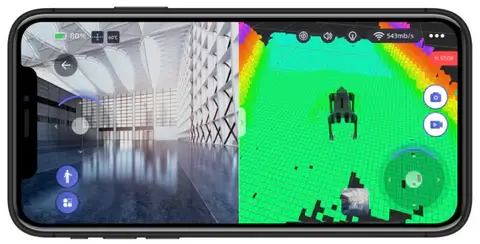
Official App: Learn to use the drag-and-drop menu in the official app The design includes instruction sequences for movement, turning, and specific actions (such as waving or taking a photo). Students will learn to create task flows and preview paths in real-time on an app or simulator. .
DroneBlocks platform applications: Through DroneBlocks' Scratch-like block-based programming courses Learn event-driven programming, such as "back up and turn when an obstacle is detected".
First Impression of Sensor Data: Learning to read 4D LiDAR data from Go2 And understand the basic principles of obstacle detection and map display in a graphical interface. .
Introduction to Voice Interaction: By combining preset commands or simple APIs, basic voice control can be implemented, allowing students to experience the charm of human-computer interaction.
Module 2: Python Programming and SDK Development (primarily using Unitree Go2 & R1)
This module is a crucial transition from graphical to text-based programming. Students will learn to use Python, a mainstream language in the industry, to control robots more precisely and in more complex ways through the official SDK (Software Development Kit).
Python SDK Basics: Learn to install and use unitree_sdk2_python The focus is on explaining how to discover and connect to robots using the DDS communication protocol. .
High- and low-order instruction control: Learn to use higher-order instructions (such as robot.set_mode("high_level")Controlling robots to enter different movement modes And low-level commands directly control joint angles, speeds, and torques.
Sensor data processing: Real-time data from IMU (Inertial Measurement Unit), joint sensors, microphone array, and camera is read and processed using Python scripts. .
State machine concept: Learn the finite state machine (FSM) management method built into the Go2Py driver to understand how to ensure safe transitions between different robot behavior modes. .
Real-world projects: Write a Python program that allows a robot to perform a series of actions: "stand up -> move forward to detect a human face -> wave -> sit down".
Module 3: ROS2 Framework and System Integration (Primarily using Unitree R1)
This module introduces students to the professional field of robot development, teaching them the most mainstream robot operation system in the industry (ROS2) and enabling multi-module collaborative work.
ROS2 core concepts: Learn the basic concepts of ROS2, such as Node, Topic, and Service, and understand its distributed communication architecture.
Topic publishing and subscription: Install unitree_ros2 Package Learn how to publish commands in the ROS2 environment. /cmd_vel Topic is used to control the robot's movement, and subscriptions are made. /joint_states Wait for the Topic to obtain the robot's status .
ROS2 graphical tools: Learn to use RViz for 3D visualization, monitoring robot models, sensor data, and coordinate transformations (TF). .userqt_graph View the relationship diagram between nodes and topics to understand the data flow. .
Launcher file: Learn how to write Launch files to enable one-click startup of multiple ROS2 nodes and quickly deploy simulated or live control environments. .
Visual programming: Introducing how to integrate Node-RED's ROS2 plugin Alternatively, you can use the visual ROS2 node editor to connect ROS2 nodes by dragging and dropping, quickly building control logic prototypes. .
Module 4: AI Applications and Advanced Development (Primarily using Unitree R1 EDU)
This module will leverage the powerful AI computing capabilities of the NVIDIA Jetson Orin processor in the R1 EDU version. Leading students to realize real-world applications of artificial intelligence and explore the frontiers of embodied intelligence.
Machine learning model deployment: On the Jetson Orin platform Learn how to run pre-trained deep learning models, such as pedestrian detection and object recognition. .
AI Vision in Practice: Using binocular cameras By combining vision libraries such as OpenCV, Python programs can be written to implement tasks such as "tracking objects of specific colors" or "identifying QR codes and reading information".
SLAM and Autonomous Navigation: By combining optical radar and visual data, the SLAM (Simultaneous Localization and Mapping) algorithm is run to create an indoor environment map and plan a path, enabling the robot to achieve autonomous navigation.
Advanced Human-Computer Interaction System: Deep integration of OpenAI API Whisper is used for speech-to-text conversion, followed by a large language model for intent understanding, and finally the pyttsx3 speech synthesis library is used. Create a voice-guided robot that can answer questions and engage in free conversation. .
Advanced applications of simulation environments: In high-fidelity simulators such as NVIDIA Isaac Sim Complex test scenarios are established to train the new algorithm using reinforcement learning. After testing the new algorithm, it is then deployed to a real R1 robot for validation. .
Request the full course syllabus
Get Vinci AI by filling out the form once. Complete course resource library Cloud access permissions. We have prepared the following documents for your convenience. Curriculum Planning and IT Innovation Lab / QEF Grant Application
-
📘 Course Unit Structure: Coverage Python LLM,AI-generated art, Unitree robotics courses, etc.syllabus
-
🤖 Hardware specifications: Unitree Robots (Go2, R1),drone swarm and UGOT Robot Hardware Details
-
🏆 Activity plan reference: STEM Day: Comprehensive Learning Day Procedures and School Competition Details
(After submitting the form, the resource library link will be sent to your email immediately.)
AI competition tips
FAQ
What grade level is this course suitable for? Do students need to have previous programming experience?
This course is offered in different levels. The Go2 graphical programming section requires no prior programming experience and is ideal for upper elementary and middle school students. The R1 advanced Python section is recommended for upper middle school students with some Python or other text-based programming backgrounds.
What are the main differences between Go2 and R1 courses?
The Go2 curriculum focuses on cultivating students' computational thinking and basic understanding of robot control through intuitive graphical tools. The R1 course delves into professional Python code and the ROS2 industry-standard framework, focusing on more complex AI algorithms and the kinematics of humanoid robots, making it more challenging. .
Does the school need to purchase robots on its own?
We offer complete on-campus curriculum solutions, including all necessary robotic teaching aids (Unitree Go2 and R1) and professional instructor guidance, which schools can purchase through us.
What if the robot breaks down?
Our company's technical team, including mechanical engineers, will assist schools with maintenance and upkeep to keep the school in optimal condition.

AI artificial intelligence courses for primary and secondary schools
Why choose Vinci AI?
As Unitree's authorized distributor in Hong Kong, we offer officially recognized hardware, ensuring higher quality. Our experienced team of instructors, including university lecturers and AI experts, will guide children to explore the world of robotics and achieve their dreams in a lively and engaging way.
University lecturer teaching team
VInci AI's teaching team is rich in experience, including university teachers who teach master's AI courses in various colleges and universities.
Curriculum developed by PhD-level experts
Vinci AI's PhD-level AI expert team, providing the most professional artificial intelligence courses
Chartered courses, quality assurance
As Unitree's distributor in Hong Kong, we offer officially recognized courses, ensuring higher quality.
Want to schedule on-campus classes?
Contact our consultants
Vinci AI offers on-campus courses, including STEM Day events, competition training, and after-school programs. We welcome you to contact our expert consultants to arrange suitable topics and formats for your needs.